I cannot in good faith go without writing an update on this issue, given the new information made available to the public. Now, the worst sounding of these news stories (the first link) consists of unofficial information, leaked to the press. The basic summary, according that news story (and since reported in a great many places, including the PBS Newshour) was that the fuel in Reactor 1 melted very shortly after the loss of power, and may have violated the integrity of the pressure vessel (there has been some throwing around of the word 'containment' in an unclear way in the press, which is not helpful). There has also been a substantial uptick in the estimated amount of radiation released.
Now, a few points here: Firstly, the last news story linked above suggests that TEPCO does not believe the pressure vessel was seriously violated, which is in line with what happened at Three Mile Island as I discussed briefly before. Second, all of the information reported thus far has been based on estimates of what took place, the size of potential breaches, new information obtained by the recalibration of instrumentation on site, etc. What this means is that these new numbers are potentially not much better than the previous, and in keeping with much of the data presented by the Japanese, is something of a worst case.
Wednesday, June 8, 2011


Saturday, June 4, 2011
And now: space!
Saturn, and its various satellites, to be more specific.
Cassini has been a spectacularly successful mission, by any standard, documenting conditions on Titan, finding water geysers on Encedalus, providing clues to the forces that form and maintain Saturn's splendid rings, and much more. It also has returned some of the most beautiful imagery of a member of the solar system thus far.
Enter Chris Abbas, who has taken the raw, uncorrected imagery, and produced a dazzling little film. It's is absolutely gorgeous, and makes just about perfect use of the 'open source' Ghosts music project, by Nine Inch Nails.
CASSINI MISSION from Chris Abbas on Vimeo.
Watch it full screen.
(h/t to Warren Ellis!)
Cassini has been a spectacularly successful mission, by any standard, documenting conditions on Titan, finding water geysers on Encedalus, providing clues to the forces that form and maintain Saturn's splendid rings, and much more. It also has returned some of the most beautiful imagery of a member of the solar system thus far.
Enter Chris Abbas, who has taken the raw, uncorrected imagery, and produced a dazzling little film. It's is absolutely gorgeous, and makes just about perfect use of the 'open source' Ghosts music project, by Nine Inch Nails.
CASSINI MISSION from Chris Abbas on Vimeo.
Watch it full screen.
(h/t to Warren Ellis!)
Thursday, May 26, 2011
Remember boys and girls...
Mother Nature is tough, and she will cut you.
This is about a block from my house.
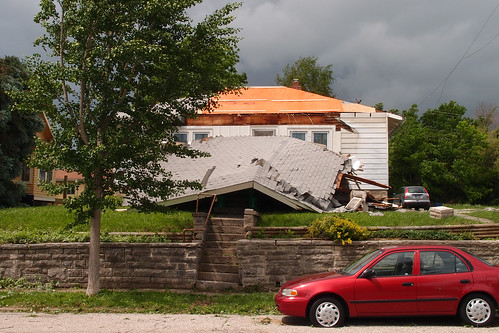
This is about a block from my house.
Wednesday, May 18, 2011
Book Review: Crow Planet
Crow Planet: Essential Wisdom from the Urban Wilderness, by Lyanda Lynn Haupt. New York: Little, Brown and Company P, 2009. 229 pp.
Among the native birds of North America, there is probably no more common or successfully adapted urban species than the American Crow, Corvus brachyrhynchos. Corvids of many stripes have been the focus of much recent research and writing, as it has become clear that they are perhaps the most intelligent of birds. While many researchers have focused on more exotic species, such as the New Caledonian Crow, or the more rare and reclusive Common Raven, the American Crow has recently been the highlight of publications out of the University of Washington (by John Marzluff, in particular), and has been the subject of an episode of the television show NOVA. Nearly ubiquitous throughout North America and an extremely common and capable urban animal, the crow also makes a natural centerpiece for Lyanda Lynn Haupt’s Crow Planet, a book that is not so much about crows as it is one that orbits around them.
Haupt is a naturalist, educator, bird lover, environmental activist and writer living in Seattle. It is in this urban setting that she tells a story that is by turns a natural history of the American Crow, including some quite good advice on how to become a naturalist in the traditional sense of the word; a collection of interesting bits of literature and history in the field of naturalism; a philosophical musing on what it means to be a naturalist, an environmentalist, or a human being living in an urban environment; and a personal confession of her battle with her own fragile condition as all three.
Among the native birds of North America, there is probably no more common or successfully adapted urban species than the American Crow, Corvus brachyrhynchos. Corvids of many stripes have been the focus of much recent research and writing, as it has become clear that they are perhaps the most intelligent of birds. While many researchers have focused on more exotic species, such as the New Caledonian Crow, or the more rare and reclusive Common Raven, the American Crow has recently been the highlight of publications out of the University of Washington (by John Marzluff, in particular), and has been the subject of an episode of the television show NOVA. Nearly ubiquitous throughout North America and an extremely common and capable urban animal, the crow also makes a natural centerpiece for Lyanda Lynn Haupt’s Crow Planet, a book that is not so much about crows as it is one that orbits around them.
Haupt is a naturalist, educator, bird lover, environmental activist and writer living in Seattle. It is in this urban setting that she tells a story that is by turns a natural history of the American Crow, including some quite good advice on how to become a naturalist in the traditional sense of the word; a collection of interesting bits of literature and history in the field of naturalism; a philosophical musing on what it means to be a naturalist, an environmentalist, or a human being living in an urban environment; and a personal confession of her battle with her own fragile condition as all three.
Sunday, May 15, 2011
Decline by Fall (part II)
As I mentioned, here is the second half of the bumblebee paper (first half here). This section is probably more accessible, as it's a good bit less technical. A quick summary of the first half: many species of wild bumblebees are in steep decline around the world, for as yet unknown reasons. Potential sources of the decline may be parasites spread by commercially reared bees, the impact of pesticides (which are not typically lethal, but which may negatively impact colony health, and on which the research is very conflicted), and problems associated with habitat loss, foraging patterns, and when bees emerge. The second part of this paper deals with how we might move to protect wild bees.
Conservation of Bumblebees
The above factors (parasites, pesticides, habitat loss, and bee phenology) may interact in unknown ways to produce the worldwide decline of some species of bumblebees. Because these bees are important for food production purposes and the maintenance of current ecosystem structures dependent on their pollination activities, successful conservation efforts will need to mitigate as many potential negative factors acting on their populations as possible, until precise, species-specific causes can be determined, and more detailed conservation plans produced. Steps such as reducing rates of parasitic infestation in commercial bumblebees are of obvious benefit to the stakeholders, while it may be more difficult to generate interest in others, such as active management of field margins, or a return to crop rotations involving fallow periods.
Conservation of Bumblebees
The above factors (parasites, pesticides, habitat loss, and bee phenology) may interact in unknown ways to produce the worldwide decline of some species of bumblebees. Because these bees are important for food production purposes and the maintenance of current ecosystem structures dependent on their pollination activities, successful conservation efforts will need to mitigate as many potential negative factors acting on their populations as possible, until precise, species-specific causes can be determined, and more detailed conservation plans produced. Steps such as reducing rates of parasitic infestation in commercial bumblebees are of obvious benefit to the stakeholders, while it may be more difficult to generate interest in others, such as active management of field margins, or a return to crop rotations involving fallow periods.
Subscribe to:
Comments (Atom)